
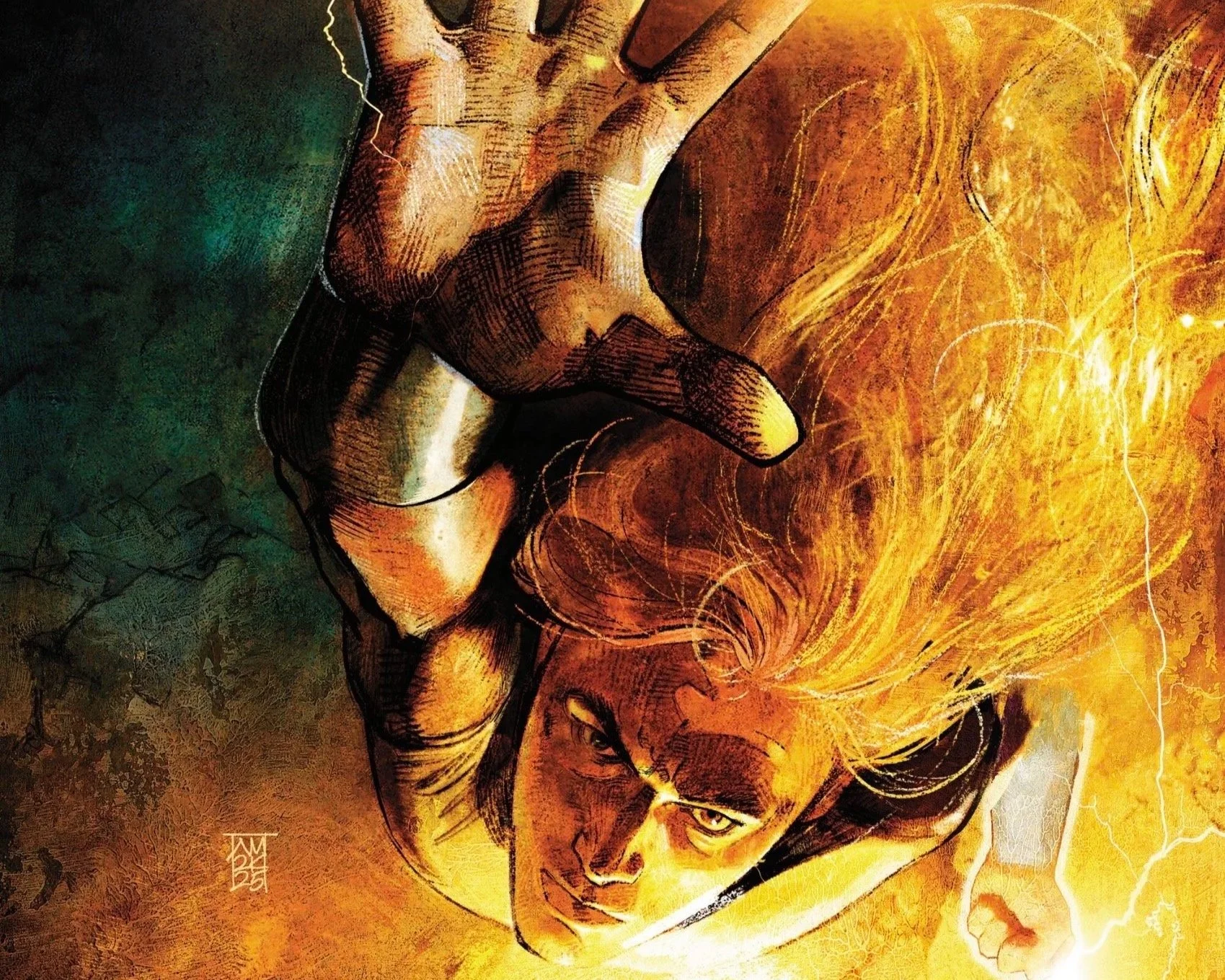
Sentry #2
Writer: Paul Jenkins
Artist: Christian Rosado
Colorist: Matt Milla
Cover Artist: Alex Maleev
A light and breezy read, this is not. Bob Reynolds, the Sentry, effectively has the powers of a god. He can do anything. But there's a cost. For every action, there is an equal and opposite reaction.
That… can’t be good for someone’s mental and emotional state.
Previously in Sentry:
Bob Reynolds, the Sentry, has returned to Earth after a lengthy time away. He refuses to talk to his wife and friends about the time he spent “in space,” brushing questions aside with a joke or a quip. Internally, he is struggling with something that happened while he was out there.
Meanwhile, the Void, Bob’s dark alter, has targeted Wilson Fisk (aka the Kingpin of Crime) and is going out of his way to destroy him.
As a strange crystalline plague appears across the world, infecting the Hulk, Bob finds out that his beloved pet Watchdog is very sick. Paralyzed by feelings of grief and helplessness, Bob is unable to bring himself to leave his dog and assist his fellow heroes…
Being Honest with Oneself
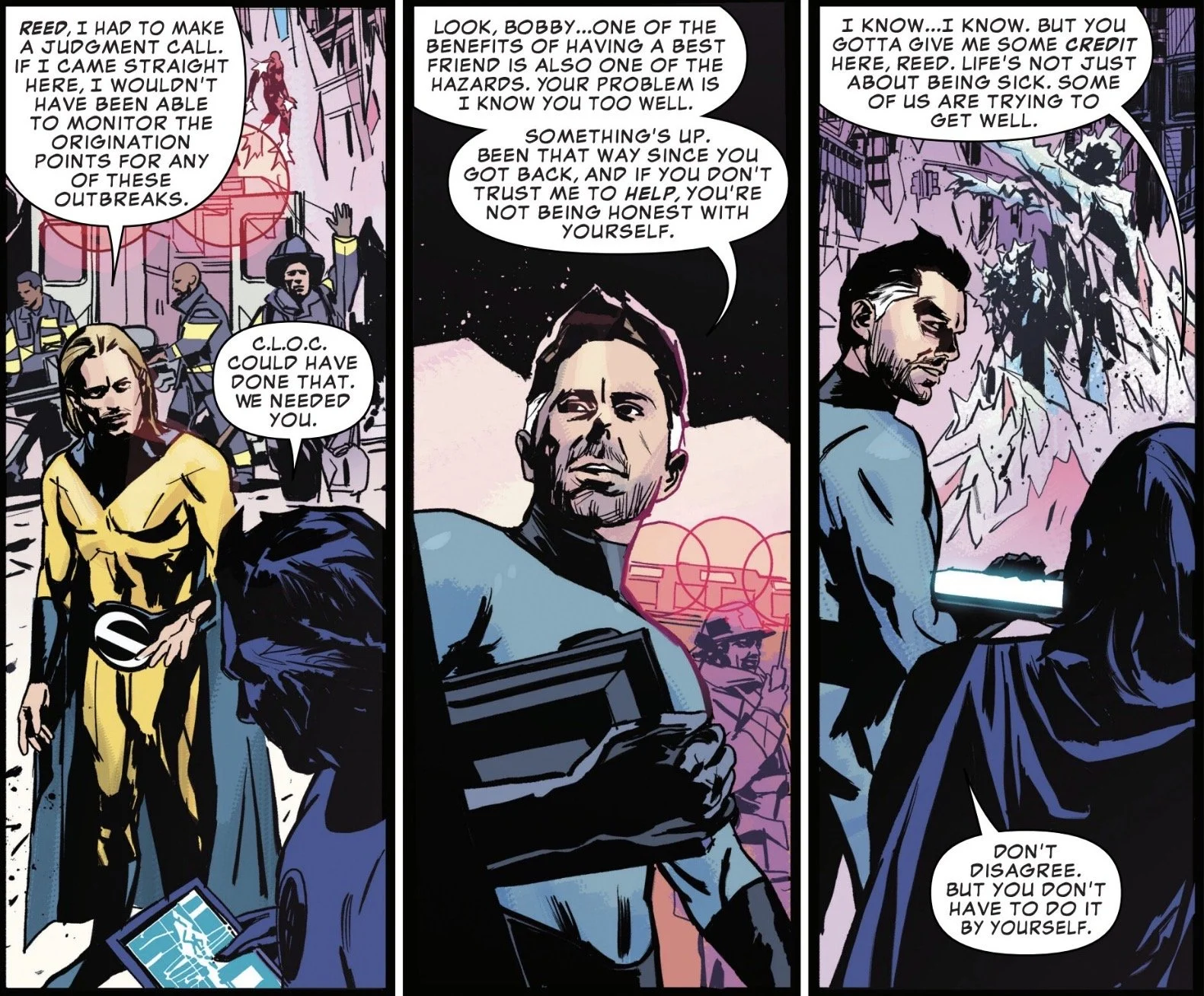
On the streets of New York City, in the aftermath of the crystalline plague outbreak, Reed Richards and Sentry are trying to figure out what it is and where it came from. Reed asks his friend where he was when the other heroes needed him. Bob tries making excuses, but Reed continues asking until he finally reveals that his pet Watchdog has cancer. Reed offers to help, but Sentry would rather talk shop.
Meanwhile, a series of news reports reveals that attacks on Wilson Fisk's holdings and properties have continued, costing him hundreds of billions of dollars. As for the man himself, he is secretly under care in a hospital facility, apparently infected with Ebola.
Sentry finds the Hulk, who is infected by the crystalline plague. He tries to talk the Green Goliath down, but as with most things gamma-related, it turns into a fight. Sentry is able to cure his friend by literally pulling the crystals out of him.
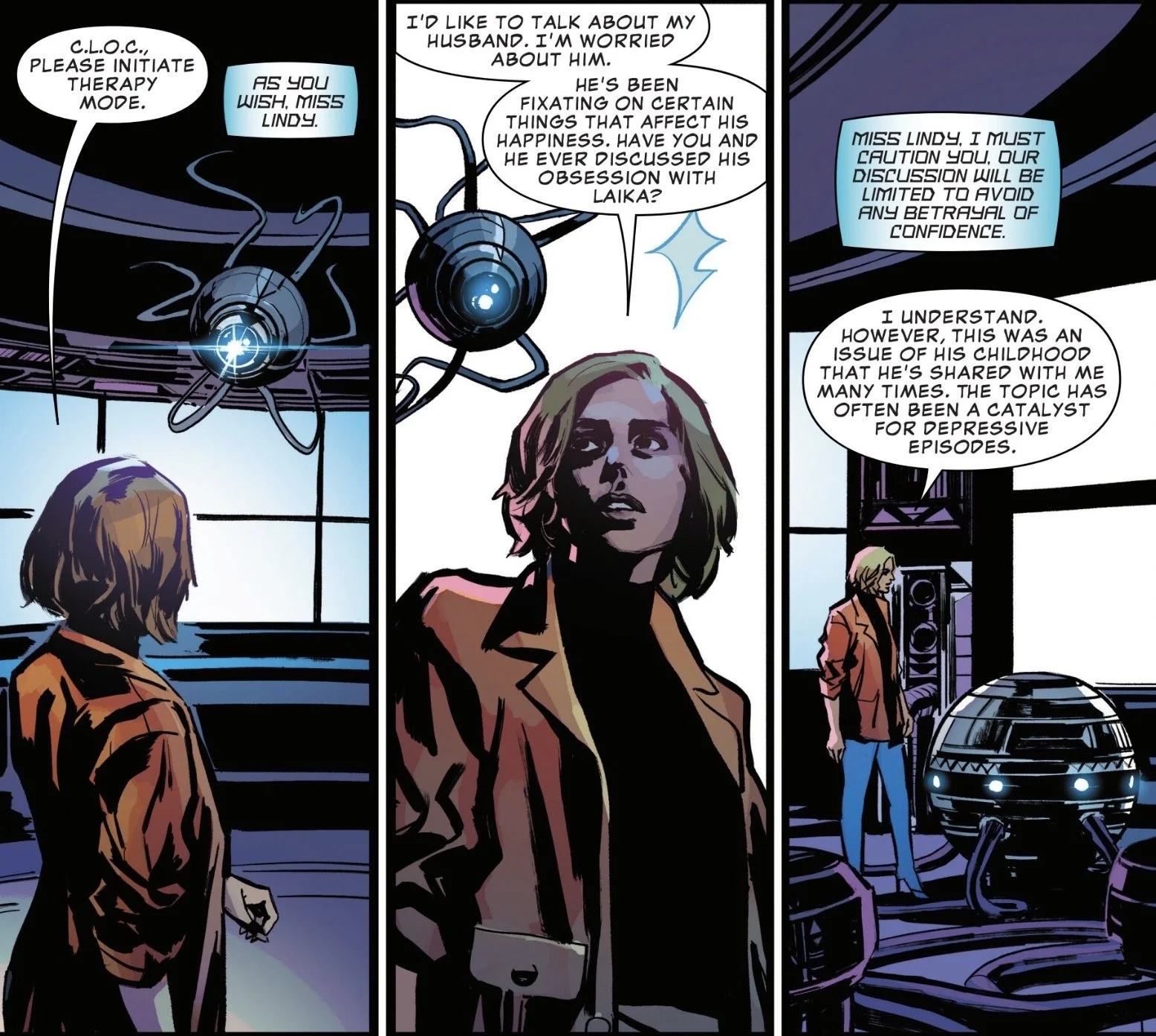
Once recovered, Bob and Hulk sit by a campfire and talk as friends. Watchdog's illness is discussed, and Hulk bids his friend “woof-woof” goodbye.
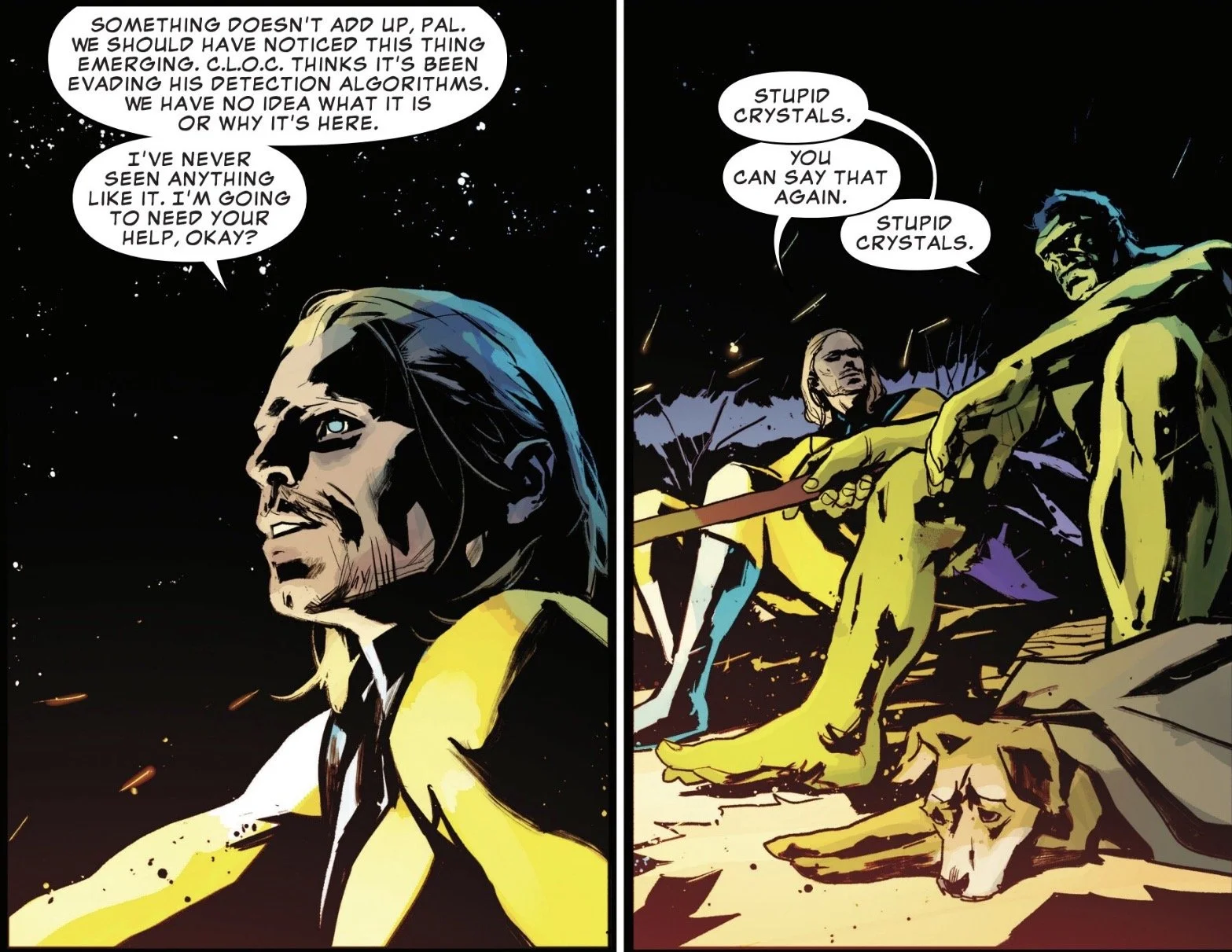
Bob's wife, Mindy, is concerned for her husband and his current state of mind, so she tries to get answers from their robotic assistant, C.L.O.C. Interspersed with her queries are scenes of the Void and the crystalline plague devastating foreign lands.
Sentry returns home and tells Mindy that he needs her help—he doesn't think he's Bob anymore; rather, he thinks he is just the Void.
The Care and Keeping of You
I myself struggle with my mental health from time to time. I think we all do at some point. So even though we don't have almost limitless power like Bob does, I think we can all relate to his struggles in some way.
Anyone who has ever had a pet can relate to what Bob is dealing with in regard to Watchdog's illness. I'm a cat person, and in my life I've lost six of the little critters. When you have a pet, they're more than just an animal; they become part of your family. When they're hurt or sick, it's the same as if one of your children is sick. And when there's nothing you can do to help them, you feel powerless. Just like Bob does here.
With his powers and the technology he has access to, Bob could easily save his dog. But he knows two things: first, no matter how much he wants it to be otherwise, that's against the natural order of things; and second, if he does something huge and "good" like that, then the Void is going to get to do something equally as huge but "bad." And that could be devastating for the whole world, not just Bob's personal one.
We can all relate. Everyone has wanted something that just can't be at some point, even if it's not on the same scale as it is for Bob.
So the book certainly has a strong emotional core. But what about the story? It's a bit of a mixed bag. I would say that your enjoyment of it will depend on how important it is for you to know exactly where it fits in Marvel continuity.
I'm of the mindset that this book is its own "thing," not tied to any particular era or time. Here Wilson Fisk is the wealthy businessman and secret crime lord, even though in recent years he's been mayor of New York, on the run, possessed by a demon, and (possibly) dead. The Hulk is his classic "savage" persona, even though I can't think of the last time that was his primary characterization. Even Reed Richards seems slightly off from his current portrayal in the Fantastic Four's own book.
The central conceit of this title - the most powerful being on the planet is losing control of his mental state and could give in to his darker impulses - is the sort of thing that almost screams for an "event" book, which would turn into an "everyone versus the Void in a knock-down drag-out fight" storyline. By treating the book as though it's outside of current continuity, I'm able to see this as a more thoughtful character piece focused on the personal emotional stakes, not so much the "Marvel universe" ones.
About the actual story in this issue - truth be told, it's pretty slight. The Void has targeted Wilson Fisk for reasons unknown, and is wreaking a path of destruction across all things Fisk. There is some kind of living crystalline plague making its way across the globe, and the Hulk is infected by it. In the midst of it all, the Sentry is doing what he can to help, but is distracted by his dog's illness. The real meat of the story is Bob's internal struggle and how the events of this series are affecting him. And that is what makes this more than your standard "super hero comic book."
A Little Help from My Friends
Writer Paul Jenkins created the Sentry (along with Jae Lee), so he knows the character better than anyone. The Marvel universe, and indeed Bob Reynolds himself, has changed considerably since Jenkins last wrote the character. While he was away, the primary take on the Sentry became "he's so crazy, look how easy it is for men like Norman Osborn to manipulate him." Now that Jenkins is back guiding his creation, there is nuance and heart in his struggles again.
Although the actual plot of the issue is nothing special, it nicely frames and gives context to Bob's own struggles. The pacing is solid, keeping things moving but still giving individual moments the time they need. The brief fight with the crystal-infected Hulk is a little bit gratuitous, but I guess a little action is expected from a supposed "super hero" book.
The art by Christian Rosado is a bit of a mixed bag. There are panels, mostly those with motion or action, that work well and look good. The images of the Void wreaking havoc around the world are impactful. Then there are other places, like the conversation between Bob and Reed Richards at the beginning of the issue, that are a lot rougher. These quieter moments look too sketchy and unfinished, made more so by the overdone hatching that is supposed to be stubble on Reed's face. The scene is a quiet conversation between close friends where there is genuine concern for Bob's mental health, and the art actively detracts from the impact it should have. This isn't to say that Rosado's work is bad, but rather that the stronger moments are so much stronger that it makes the lesser ones all the more noticeable.
Matt Milla's colors are more subdued here than those of many modern comics. This is befitting the darker and more personal tone of the story. He does some great things with light and reflections, such as the surprisingly sweet campfire scene between Sentry and Hulk. Throughout the story, he uses color to give visual hints of the blurring between the Sentry and the Void. Both have the same golden effect on their eyes when using their powers, and the shadowing on Sentry's face throughout the issue reflects the Void's own coloring. These effects serve as strong visual hints to Bob's revelation at the end of the issue, making the colors an integral part of the overall storytelling.
Seeking Help

Sentry #2 is a deep, interesting issue that has more to say than your standard super hero comic, with a strong focus on mental health and the effects of grief and helplessness. It's not an easy read, but it's the kind of thing that will speak to anyone who has struggled with their own mental health, even if they don't have godlike superpowers. We all want to feel like we're not alone, even if we resist asking for help. The sooner we realize that we don't have to do it alone, the better off we'll be—a lesson that Bob Reynolds still needs to learn. If you want to see a thoughtful, nuanced portrayal of mental struggles that happens to feature some super hero action at the same time, look no further than this comic.